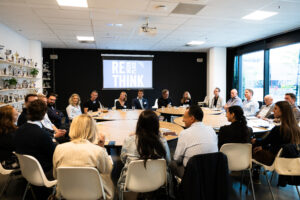
On September 17, Maptician joined Rethink Workplace and Vecos at B. Amsterdam for an executive roundtable on workplace data and AI. Rethink Workplace hosted, and the room was full: about 20 organizations spanning corporate real estate, facilities management, and IT, including leaders from Adyen, ASML, JP Morgan, Rituals, ASN Bank, Rijkswaterstaat, Versuni, and Keywords Studio.
The idea that framed the day came from Rethink Workplace’s own write-up: trusted data asks better questions, and AI just asks them faster. Five themes ran through the conversations, and they connect more tightly than any one of them does alone. Here’s what stood out to us.
1. Data quality is still the biggest obstacle
Most organizations aren’t short on workplace data. They’re pulling from badge systems, sensors, manual counts, and booking tools. The trouble is that these sources rarely agree, so nobody fully trusts the result. When real estate teams can’t rely on the numbers, every department ends up defending its own version of the truth. The fix, according to the group, usually isn’t another sensor. It’s deciding which source answers which question, reconciling the rest against it, and being honest about the gaps. One client in the discussion found their average space utilization was around 50%. That’s a number with serious portfolio consequences, but only once everyone in the room accepts it.
This is a point we feel strongly about at Maptician. A booking tells you who planned to come in. Presence data tells you who actually did. Attendees noted that scheduled attendance and actual attendance can look very different, and that difference can change the entire conversation about space.
2. Good data takes discipline
Data doesn’t stay accurate on its own. Teams move, floors get reconfigured, and policies change, and the digital record slowly drifts away from what’s physically there. Participants emphasized that long-term success depends less on the initial setup and more on the habits that keep the digital and physical workplace aligned. In practice, that means treating workplace data like any other business asset: someone owns it, changes are captured as they happen, and there’s a regular check that the system matches the floor. The organizations doing this well update the floor plan and the data at the same time as every move or refurbishment, rather than saving it for a cleanup project months later.
3. Connected data needs privacy built in
The most valuable insights rarely come from a single dataset. A return-to-office decision, for example, touches occupancy, but also attrition risk and engagement (HR), network and operational dependencies (IT), and service impact (facilities). Every organization in the room raised the same condition: connecting data only works if privacy is designed in from the start. Aggregating and anonymizing at the right level, being transparent with employees, and agreeing on ownership across HR, IT, and facilities before anything is connected all build the trust that makes sharing possible. Done well, privacy becomes the thing that enables connected data rather than slowing it down, particularly in Europe, where GDPR expectations are high.
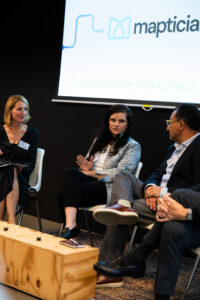
Katherine Harvey (Rethink Workplace) discusses the use of data with sponsors, Maptician
4. “AI-ready” only means something when it’s tied to a problem
The group was refreshingly grounded about AI. The organizations getting real value aren’t deploying it for its own sake. They’re using it to answer questions people already had, faster and with less friction. Today, most workplace data sits with a handful of specialists who field requests from everyone else. A simple, conversational layer on top of trusted data lets a facilities manager, portfolio lead, or HR partner explore it directly, so the conversation can shift from “what happened?” to “what should we do next?” It also reframes readiness: it’s about having data that’s clean, governed, and connected enough to be trusted by an AI tool. In that sense, the first three themes are all AI preparation.

Peter Thompson (Rethink Workplace) catches up with attendees at the start of the event
5. The change gap
The theme nobody quite named out loud was about people. C-suites are asking for AI. Managers in the middle are expected to make it real, often without a clear picture of what good looks like. And employees are already experimenting on their own, sometimes paying for AI tools out of pocket, which creates a risk of unmanaged “shadow AI” that’s invisible to the business. None of these groups is wrong; they’re just moving at different speeds. Closing the gap takes more than a training course. It takes a clear operating model, a realistic budget, and a willingness to bring early experimenters inside the tent. The organizations that pull ahead will treat people, technology, and place as one connected system rather than three separate programs.
Rethink Workplace’s takeaways translate into a practical set of priorities.
• Fix the foundations first. A smaller set of data everyone trusts beats a larger set nobody does.
• Make ownership explicit. Without a named owner, drift is a certainty.
• Bring privacy in early. Designing it in is much faster than retrofitting it.
• Start AI with a question. One well-chosen use case builds more confidence than a broad program with no clear outcome.
• Close the change gap. Give managers the clarity, time, and budget to lead change.
And one more, because it came up as well: be patient. If it takes roughly a year for a new occupancy pattern to become habit, the data and decisions around it need the same runway. Conversations like this one shape how we think about workplace intelligence at Maptician. Trusted, real-time presence and space data is the foundation everything else in this list depends on, and hearing leaders from such different organizations describe the same challenges reinforced how important that foundation is.
A big thank-you to Rethink Workplace for hosting, to Vecos for partnering with us, and to everyone who joined the discussion. We’re planning to bring similar roundtables to the U.S. in 2027, so stay tuned and follow Maptician for updates.
See How Maptician Works
Discover a smarter, more connected way to manage the modern workplace.